

An Analysis of the Iranian Front in the 2026 Iran War
Introduction
In our previous work titled 'The Anatomy of the US-Iran War: Eight Strategic Mistakes', we discussed the strategic vulnerabilities in Washington's military and political planning. Now we look at the other side of the coin; we evaluate the 2026 war from the perspective of Iran under attack. The conventional power asymmetry between the Israeli-backed American war machine and Iran is an indisputable fact. However, despite this deep military inequality, we have constructed our analysis without compromising the fact that the parties are equal and sovereign states under international law.
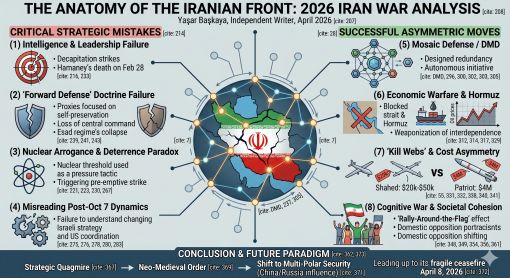
1. Intelligence Failure, Inability to Protect Leadership, and Diplomatic Arrogance
At the forefront of Iran's most fatal strategic mistakes is its failure to foresee the intentions, coordination, and timing of the attack by the US and Israel. Tehran, which failed to learn the necessary lessons particularly from the operations executed during the "12-Day War" in June 2025 (Israel's Operation Rising Lion and the US's Operation Midnight Hammer) and from previous 'decapitation' moves, was unable to adequately protect its decision-making centers and top-level leadership. At the core of this lack of foresight lies the inability to read the coordinated "strategic and operational deception" tactics of the US and Israel that lasted for months. Israel and the US manipulated satellite imagery to create the impression that bases were empty and fighter jets were unarmed, diverted Iran's attention with fake intelligence leaks such as the deployment of F-22 aircraft, and even applied subtle tactics like high-ranking figures such as the Israeli Chief of General Staff returning home without using their official vehicles so the headquarters would appear in a routine state. This created atmosphere of complacency caused high-ranking Iranian officials, who believed an attack was not imminent, to continue gathering in person.
Another important detail; Iran overly relied on the image of an "invincible regional power" that it had built by surviving and resisting intense sanctions and Western pressure for decades. However, the factor that truly turned this self-confidence into arrogance was the "nuclear threshold state" status the country had reached. Although they had not yet actually produced a nuclear weapon, the Tehran administration had acquired a massive stockpile of highly enriched uranium (60 percent purity) capable of making a nuclear bomb in a short time. Iran viewed this potential nuclear capacity as an absolute deterrence and diplomatic blackmail tool providing immunity against the US, and sat at the table not as a weak state, but "as if it were a nuclear power". Supreme Leader Ali Khamenei's threat to sink American warships by stating during negotiations that he found the US's zero-enrichment demands "stupid" was one of the clearest indicators of this overconfidence. According to the account of analyst Yoni Ben Menachem, who is close to Israeli security circles, the Iranian delegation (especially Foreign Minister Abbas Araghchi) boasted about their nuclear capabilities during meetings with US envoys Steve Witkoff and Jared Kushner; Ben Menachem evaluated this atmosphere as a concrete example of Iran's overconfidence, and even though this account has not yet been verified by independent sources, the public statements of Iranian officials during the same period indicate that a similar attitude was displayed at the table. Furthermore, the Iranian delegation was so focused on using its nuclear capacity as an instrument of pressure and boasting about its own power at the table that; this diplomatic myopia prevented the Tehran administration from noticing the surprise military preparations conducted by the US and Israel in the background. Completely miscalculating the seriousness of President Trump and Israeli Prime Minister Netanyahu's intentions, Iran failed to see that while hoping its nuclear blackmail would force the other side to back down, it was actually encouraging them to carry out a deadly "pre-emptive strike" targeting its own leadership cadre directly, and creating an excuse for this attack.
Even though it was reasonably foreseeable that Israel could target Supreme Leader Ali Khamenei, the failure to increase the protection measures for the top leadership points to a profound intelligence and systemic error. Indeed, on the morning of February 28, three separate gathering points where high-ranking officials of the Iranian regime were located were struck flawlessly and simultaneously half a minute apart. In addition to Khamenei, the killing of key figures such as Chief of General Staff Abdolrahim Mousavi, Defense Minister Aziz Nasirzadeh, and Mohammad Pakpour, the commander responsible for the Islamic Revolutionary Guard Corps' (IRGC) regional proxy networks, while they were together in the very first hours of the war, initially created a leadership vacuum. Moreover, coalition forces directly targeted and bombed the buildings of the Assembly of Experts, which is constitutionally tasked with electing the new supreme leader, in both Qom and Tehran. Subjecting the highest constitutional institutions of the regime to physical destruction in this way dragged the successor selection process into a constitutional crisis, disrupting it symbolically and operationally. As we mentioned in our first article, this is a tactically flawlessly executed operation. However, strategically, as a result of this operation, the Iranian system did not collapse as we explained in our first article, but changed shape. This operation led to the purge of the regime's moderate wings; paved the way for power to practically fall into the hands of the IRGC and more hawkish, uncompromising figures like Khamenei's son Mojtaba Khamenei, causing the country to evolve into an even more radicalized military structure.
2. The "Forward Defense" Doctrine Turning into a Boomerang
Iran's security concept has for decades been built on "meeting and absorbing threats in the geographies where proxy forces are located (Lebanon, Syria, Iraq, Yemen) before they reach Iran's borders". However, by the time of the 2026 war, it was seen that this network (Axis of Resistance) failed to provide the expected deterrence and largely lost its operational value. The main reasons for this situation are as follows:
- Attrition of Proxy Forces and Focus on Their Own Survival: When the war began, instead of forming an umbrella to protect the Iranian mainland, Iran's proxy forces were forced to focus on their own organizational survival struggles.
- Hezbollah: Becoming Israel's primary target, Hezbollah lost a large part of its top leadership cadre and found itself having to engage in a large-scale ground/air war with Israel in its own geography.
- Hamas: Entirely focused on preserving its own organizational integrity and disarmament negotiations in Gaza; it regressed to the position of a historical ally rather than being under Iran's immediate command.
- Syria: The collapse of the Bashar al-Assad regime eliminated the most important land bridge and strategic depth providing logistics to Iran's proxy network, reducing the contribution of militias in Syria to a marginal level.
- Decentralization of the Network and Loss of Coordination: Iran's "Forward Defense" strategy relied on a centralized command structure managed from Tehran. However, with the liquidation of high-ranking Iranian liaison officers and the command echelon, this network was fragmented. Iraqi Shia militias were divided, preferring to protect their own political and economic positions within the Iraqi state rather than entering an all-out war for Iran's interests. The Houthis, on the other hand, made their regional calculations in line with their own interests and began to act on their own initiatives rather than directly following Tehran's schedule.
- The "Crush the Snake's Head" Strategy and Bringing the Conflict to the Center: The biggest weakness of Iran's "Forward Defense" doctrine was the assumption that the opposing side would not change the rules of engagement. However, after October 7, 2023, Israel changed its security paradigm, transitioning to the "crush the snake's head" strategy, and chose to target the Iranian mainland directly as the source of the threat. Cross-border operations of proxy forces, rather than deterring Israel and the US, turned into a justification providing legitimacy for striking Iran's nuclear facilities, air defense systems, and military infrastructure on its own soil.
- Formation of a Counter-Bloc and Financial Unsustainability: Iran's policy of expanding its sphere of influence in the Arab world through proxy forces was perceived by regional states (Gulf countries) as a destabilization attempt. This situation paved the way for the formation of a Sunni political-religious bloc against Iran. At the same time, financing, providing logistics for, and coordinating this massive proxy network became an increasingly unsustainable burden for the Iranian economy, which has been under sanctions for years.
In summary; Iran's strategy of protecting itself by keeping the conflict in Lebanon, Syria, or Iraq (Forward Defense); became dysfunctional due to proxy forces experiencing a drop in capacity, the network losing its central command, and the determination of the US-Israeli axis to directly target Iranian geography. The proxies losing their protective function resulted in all the physical destruction of the war falling directly upon the Iranian army and Iranian territory.
3. Public Declaration of Nuclear Production Capacity and the Deterrence Paradox
Iran's fundamental strategic dilemma in the context of its nuclear program is publicly declaring that it has reached the capacity to produce nuclear weapons in a short time (threshold state status) without possessing an actual nuclear weapon. According to some claims based on closed Israeli sources, it was alleged that Iranian Foreign Minister Abbas Araghchi stated during negotiations with US representatives Steve Witkoff and Jared Kushner that Iran had the capacity to 'produce 11 nuclear bombs in a short time'. However, beyond this single-source claim, the situation that created the real strategic fracture was the verifiable public statements of Iranian officials. As reflected in security reports; high-ranking officials such as Kamal Kharrazi, an advisor to the Iranian Supreme Leader, and Ahmad Haghtalab, the commander responsible for the security of nuclear facilities, publicly stated that the nuclear doctrine (the fatwa against producing weapons of mass destruction) could be changed if the country faced an existential threat.
This public declaration policy had two direct consequences on the ground and in diplomacy:
I. Triggering of a Pre-emptive Strike: Voicing nuclear capacity as an overt instrument of pressure at the negotiating table altered the risk perception of US and Israeli decision-makers. Knowing that Iran's breakout time had theoretically dropped from 2-3 months to as little as a week, and this capacity being verbalized by Iranian officials, led the threat to be coded as "imminent/a matter of time" by Washington and Jerusalem. Consequently, instead of forcing the US and Israel to back down, these statements accelerated the operational schedule of a joint pre-emptive military campaign, pushing them to act before Iran had the chance to turn this capacity into an actual weapon.
II. Creating International Political Ground and Legitimacy for the Attacking Party: Iran's explicit declaration that it had reached the threshold to produce a nuclear bomb offered the US and Israel an ideal political ground to justify their military interventions. International law experts (e.g., Susan Akram) and UN officials state that because there was no actual armed attack carried out by Iran (Article 51), this military campaign is "illegal" according to international law and cannot be considered self-defense. However, despite these legal objections, Iran's own statements provided the leaders initiating the campaign with a powerful political argument. US President Trump and Israeli Prime Minister Netanyahu framed their actions diplomatically by declaring that the operation was conducted to "eliminate the existential and imminent nuclear threat posed by the Iranian terror regime." Indeed, the fact that some European leaders, like German Chancellor Friedrich Merz, took refuge in the argument that "Iran must be prevented from acquiring nuclear weapons" in their statements supporting the operation shows how useful a ground of legitimacy Iran's own declarations provided for its adversaries.
4. Misreading the Changing Israeli Strategy and Washington Dynamics Post-October 7
The attacks carried out by Hamas against Israel from the Gaza Strip on October 7, 2023, and the events that unfolded subsequently, paved the way for a radical change in Israel's security perception and the formation of a new regional reality. From that date forward, Israel underwent a strategic transformation toward expanding the conflict area, taking more resolute military steps, and changing its old operational paradigms. Israel's transition to the "crush the snake's head" strategy, aimed at destroying the threat directly at its source instead of clashing cross-border with proxy forces, and moving operations to the Iranian mainland is the main result of this change. However, Iran failed to evaluate this structural transformation in its adversary's security perception and continued to act within the framework of obsolete rules of engagement.
Simultaneously, Iran also failed to correctly analyze the internal political structure of the United States and the dynamics steering the decision-making mechanisms in Washington. In US domestic politics, there were assessments voiced by strategic circles and White House advisors that it would be politically more suitable for the US administration if Israel took the first strike against Iran. During the same period, there is data indicating that Israeli Prime Minister Netanyahu conducted intensive coordination with US President Trump's administration for months, securing political cover and a green light for the planned attack. The Iranian side was unable to foresee the level of this close operational and political coordination between the US and Israel.
In the diplomatic arena, by rejecting multilateral diplomatic opportunities such as the "Istanbul talks" proposed by Turkey to include regional actors; Iran preferred to keep negotiations strictly bilateral (US-Iran) via Oman. This choice narrowed Iran's flexibility to form a regional diplomatic shield against the impending attack. According to analyses by senior security sources; had Iran fully understood the political pressures in Washington and Israel's strategic shift, it could have developed a new diplomatic maneuver capable of derailing the joint US-Israeli campaign before it even began.
Iran's Successful Asymmetric Strategic Moves
The intelligence failures detailed above and the flawless "decapitation" attacks directed at the command echelon in the first hours of the February 28 operation had, according to classic military theories, created conditions that required the Iranian army to rapidly paralyze and the system to collapse. However, the reality on the ground and the advancing weeks of the war showed that this expected systemic paralysis did not occur. Faced with the absolute conventional air and technological superiority possessed by the US and Israel; Iran transported the conflict outside traditional military rules of engagement onto an asymmetric, economic, and cognitive plane in order to survive.
This second part of our analysis focuses on the strategic doctrines that allowed Iran to maintain its fighting capacity despite heavy physical devastation and profound conventional power inequality. Iran absorbed the initial military shocks with its decentralized, flexible command structures, imposed an unsustainable defense economy on its adversary using low-cost autonomous weapons, and most importantly, exported the cost created by the war directly to the global economy via transit risks in the Strait of Hormuz. These maneuvers, which rendered classic war theories moot by expanding the geographical and structural boundaries of the conflict, stand out as Iran's asymmetric strategic right moves.
5. The "Mosaic Defense" Doctrine and Decentralized Command
The "decapitation" operation implemented by the US and Israel in the first hours of the war had a fundamental assumption: When Supreme Leader Ali Khamenei, the Chief of General Staff, and high-ranking IRGC commanders were eliminated simultaneously, the Iranian army would be paralyzed, and the chain of command would collapse. However, this expected systemic paralysis did not materialize. Iran managed to initiate coordinated missile and drone attacks just one hour after Khamenei's assassination. The greatest asymmetric and doctrinal success that allowed Iran to overcome this massive shock was immediately activating the "Decentralized Mosaic Defence" (DMD) system it had developed over the years. The core features and field reflections of this system have been as follows:
- "Decentralized War" Architecture and Designed Redundancy: Knowing the capital and top management would be the first targets in a possible US attack, Tehran built its military networks on the doctrine defined by W.A. Rivera from Marine Corps University as "designed redundancy." By taking decision-making authority away from the center and distributing it to institutions and local IRGC commanders, this redundant structure prevented a collapse by insulating the system against external leadership assassinations.
- Autonomous Initiative and the Survival of a "Decapitated System": Thanks to the Mosaic Defense strategy, which shifts command from the center to local units during wartime, local IRGC commanders possessed the authority and autonomy to continue fighting without waiting for orders from Tehran or a central headquarters. Contrary to the 20th-century logic of "the center gives orders, the periphery executes; if you cut off the head, the arms are paralyzed"; in Iran, when the head was cut off, the system did not collapse, but instead turned into a much more unpredictable, independent, and multi-actor network freed from the strategic discipline of the center.
- Integration with Proxy Forces and the "Two-Sided Coin" Paradox: This decentralized structure was designed to include not only regular troops within Iran, but also elements of the "Axis of Resistance," such as Hezbollah and Iraqi Shia militias. Despite the killing of Iranian liaison officers, local commanders of proxy forces took the initiative, shifting into a semi-autonomous operation mode, and continued the war from their own geographies. As I pointed out in the previous section, although this autonomization meant a failure in the proxy networks' function to protect the Iranian mainland, the very same decentralized design is the structural feature that enabled Iran's internal command network to survive the initial shock. It is essentially two sides of the same coin: it collapsed as a deterrence shield, but functioned as a survival mechanism.
In conclusion: The Mosaic Defense doctrine allowed Iran to sustain its military operations even in the event of the killing of its top leaders, thwarting the US plan to "end the war quickly by eliminating the leadership." Although this structure that eliminates hierarchy harbors the risk of sometimes leading to uncoordinated missile attacks and unintended escalations, it has entered the literature as a tremendous strategic defense mechanism enabling a state to survive an existential crisis of "decapitation."
6. The Strait of Hormuz and the Weaponization of the Global Economy (Insurance Wars)
The most prominent asymmetric strategy Iran displayed against the conventional military superiority of the US coalition in the 2026 war was moving the conflict zone from the physical geography to the plane of global finance and economics. This doctrine, defined in political science literature as the "weaponization of interdependence," tangibly reflected on the ground during the process of shutting down the Strait of Hormuz.
Iran did not enter an all-out naval war in the Strait of Hormuz, the world's most critical energy transit route, nor did it try to establish a blockade using naval power by physically sinking ships. Instead, by jamming GPS signals and creating a certain level of potential threat in the region, it effectively made the strait risky for commercial passage. The primary target of this asymmetric strategy was not military elements, but the insurance companies (P&I clubs) that insure 90 percent of the world's transoceanic commercial tonnage. With the region declared under "maximum war risk," the war-risk insurance premiums for ships increased more than a thousandfold overnight. As a result of insurance costs rising to commercially unsustainable levels, a collapse of 90 to 94 percent was experienced in strait traffic, where an average of 37 tankers passed daily. The striking operational reality is this: Even though the US possessed air superiority in the region, those who effectively closed the strait to trade were the London and Wall Street-based insurance giants that stopped issuing policies due to security risks.
The repercussions of this applied financial and geographic blockade on global energy markets have been extremely devastating:
- With the escalation of the crisis, the price of Brent crude oil quickly rose to over $111 per barrel.
- Europe's natural gas benchmark price (TTF) recorded an instantaneous spike of 41 percent.
- The severity of the situation was defined as the "greatest global energy security challenge in history" in an assessment made by International Energy Agency (IEA) Executive Director Fatih Birol on March 20, 2026.
- Furthermore, the effective closure of the Strait of Hormuz to trade was characterized as the largest disruption in global energy supply seen since the energy crisis in the 1970s, placing the gravity of the situation into a historical perspective (Middle East Eye, 2026).
Conclusion: Iran's weaponization of the global economy via the Strait of Hormuz turned into a primary leverage that allowed the country to survive at the diplomatic table despite the heavy physical damage taken on the military front. This new concept of "insurance wars," where military power could not beat insurance mathematics (actuarial science), confronted the US and its European allies with colossal economic costs like rising global inflation, logistics disruptions, and energy crises, going down in literature as the most important structural factor forcing them into a ceasefire.
7. Software-Defined Kill Webs and Cost Asymmetry
Another distinct strategy Iran displayed against the technological superiority of the US and Israel in the 2026 war is its success in transforming its conventional military capacity gap into an asymmetric war of attrition via low-cost autonomous systems and "Software-Defined Kill Webs". The reflections of this strategy on the operational field and the defense economy (cost balance sheet) of the war are read through the following parameters:
Network-Centric Strike Power and Technological Integration: In its operations, Iran established software-defined kill webs that ensured target data was rapidly processed and simultaneously distributed to numerous autonomous platforms (UAV swarms). According to strategic assessments by the Hudson Institute; a modern Iranian drone has ceased to be merely a national weapon and has acquired the nature of a "coalition weapon." As a matter of fact, advanced Shahed variants, integrated with direct combat data transferred from the Ukrainian theater thanks to defense cooperation conducted with Russia and with multinational supply chains like Chinese-origin microchips, constituted the striking power of these networks. This decentralized and autonomous strike power saturated the coalition's air defenses, causing operational damage to advanced radar systems of the US and Israel.
"War of Pennies Against Dollars" and Mathematical Asymmetry: Against the US defense industry's principle of producing a small number of high-cost super systems, Iran fielded an intense volume (mass) by adopting the "do not calibrate, escalate" strategy. According to operational statistics, the unit production cost of the Shahed-type suicide drones used by Iran is between $20,000 and $50,000. In contrast, the US and its allies used Patriot PAC-3 interceptor missiles, each costing approximately $4 million, against these low-cost drones. Consequently, the cost of stopping a $200,000 Iranian attack package, combined with the fired missiles and the flight costs of 4th and 5th generation fighter jets costing hundreds of thousands of dollars per hour, cost the coalition millions of dollars.
Ammunition Consumption Rate and Logistics Vulnerability: This cost asymmetry turned the ammunition consumption rate, known in modern war literature as the "burn rate," into a structural problem against the US. The intense use of asymmetric weapons in swarms consumed the strategic air defense arsenals the US and its allies allocated globally (for other possible crisis regions like the Indo-Pacific and Europe) at an unsustainable rate. This situation proved that the logistics supply chain and ammunition economy of an advanced army in an armed conflict can be consumed as the primary target itself.
Conclusion: Low-cost autonomous systems coordinated via software-defined networks pushed conventional air defense budgets to a mathematically unsustainable point. This strategy of Iran has entered the literature as a successful asymmetric attrition doctrine established against the ammunition spending capacity of the US coalition, targeting their defense economy, production capacities, and stock depth rather than the weapons (drones) themselves.
8. Cognitive Warfare, Cultural Dynamics, and Societal Cohesion (The "Rally-Around-The-Flag" Effect)
Another factor strengthening Iran's asymmetric defense capacity in the 2026 war is reversing the internal collapse expected to be created by the US military campaign through information operations and a national defense narrative. The operational and sociological foundations of this situation are based on the following data in the sources:
The US's "Internal Uprising" Assumption and Failure to Read Strategic Culture: US military planning was based on the assumption that heavy bombardments and pressure would alienate the Iranian people from the regime through an individual rationality, ultimately pushing them into an internal rebellion. However, US policies failed to factor into their equations the deep-rooted "Strategic Culture of Resistance" that Iran developed against historical external pressures. While Iran was viewed merely as a threat needing to be controlled, it was not fully understood as a civilization and state tradition possessing sociological continuity.
Triggering the "Rally-Around-The-Flag" Effect: The beginning of the operation, damage to civilian areas, and the direct striking of the country led to the public gathering around the state with a nationalist reflex (societal cohesion), contrary to the expected break-off. According to social psychology models (e.g., Hofstede's cultural dimensions), Iranian society, which is collectivist and has a high tendency for "uncertainty avoidance," stepped under a collective defense umbrella instead of individual escape in the face of an external existential threat.
The Opposition Shifting Position and Breathing Room Opening for the Regime: While the regime was under severe civilian pressure with the 2022 protests and the January 2026 demonstrations right before the war, the external military campaign opened a new space (parenthesis) for the Iranian administration to consolidate domestic politics. The Iranian administration marginalized the domestic opposition by successfully transforming the war into a "homeland defense" narrative. Striking civilian infrastructure and cities with missiles was perceived in a way that confirmed the regime's "US imperialism" rhetoric in the eyes of the masses; even openly anti-regime activists and figures from the 2022 protests stated they were forced to position themselves alongside the state in the face of external military destruction.
Conclusion: The US's use of merely coercive military power and destruction failed to achieve its strategic goal (anti-regime mass rebellion) due to an inability to read Iran's societal codes. On the contrary, external attacks brought the necessity of "defending the homeland" to the forefront of aspirations for democratization in Iran, allowing the regime to temporarily freeze its legitimacy crisis with the domestic public, and fortified Iran's home front by uniting the people around the state apparatus.
Conclusion: The Structural Balance Sheet of the War and the New Security Architecture
The US-Iran war starting on February 28, 2026, is not only a battle where the conventional capacities of two states collided; it is a structural breaking point where the traditional war theories of the 20th century and the network-centric, asymmetric resistance doctrines of the 21st century were tested. As set forth throughout our analysis; Iran paid colossal costs in its command echelon and physical infrastructure due to its doctrinal choices, such as failing to read the escalation dynamics of the crisis, overflowing the boundaries of the "Forward Defense" doctrine, and explicitly declaring its nuclear capacity without converting it into actual deterrence. However, despite this heavy conventional devastation; the immediate activation of decentralized autonomous structures through "Mosaic Defense," the weaponization of global energy supply chains (via insurance risks), and targeting the adversary's ammunition economy with low-cost autonomous systems prevented Iran from experiencing an all-out systemic collapse.
Looking from the US and Israeli coalition front, the operation turned into a strategic quagmire because there was no "day after" strategy to translate these military gains into a political order, despite absolute air superiority and tactical "decapitation" successes. This conflict proved that sheer conventional military destructive power is not a sufficient political strategy alternative to manage or transform a state possessing sociological depth and redundant network structures. In this new model where adversaries fight not over physical facilities but over their economic interdependence (neo-medieval order), the center of gravity of the war shifted from the frontline to global markets.
Ultimately; this war, where classic strategic categories, frontlines, and absolute "winner-loser" equations have lost their validity, will enter the literature as a conflict from which both Washington and Tehran emerged with heavy structural damage. As I stated in my first article, it is still too early to tell whether the real strategic gain in this war lies with Beijing or Moscow. The fragile ceasefire that came into effect on April 8, 2026, represents the beginning of a new, much more complex, and uncertain Middle East security paradigm where global energy security, alliance relations, asymmetric warfare, and the limits of nuclear deterrence are redefined, rather than a final solution.
Yaşar Başkaya, Independent Researcher & Writer | April 2026