

The Anatomy of the US-Iran War: Eight Strategic Mistakes
Introduction
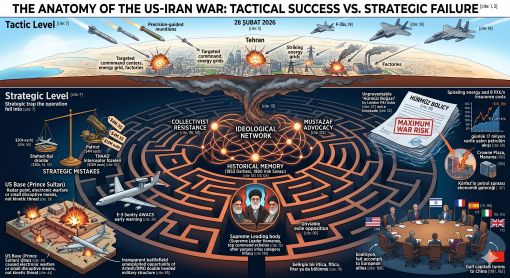
On February 28, 2026, Washington and Jerusalem launched a comprehensive and joint operation against Iran: codenamed "Epic Fury" by the US, and "Roaring Lion" by Israel. As of April 20, 2026, there is a fragile negotiation process struggling to proceed through extensions. In this article, I examine under eight headings why this operation, executed almost flawlessly at the tactical level, has become bogged down at the strategic level.
Before beginning, I would like to state: The following analysis primarily brings to the table the mistakes on the US front. Iran has also paid heavy prices in this war—the loss of Khamenei, the destruction of a large portion of its ballistic missile launchers, and hundreds of billions of dollars of devastation in its economy. Saying "the US did not win" does not mean "Iran won." The issue I examine below is about why tactical superiority did not translate into political victory; it is not an analysis of who is the victor and who is the vanquished.
Strategic Mistake 1: The Wrong Map - Trying to Strike a 21st-Century Rival with a 20th-Century Warfare Model
US military planning has been based on a single core idea for decades: view the enemy as an interdependent system, strike the critical nodes of that system—factories, energy grids, command centers—and watch the system collapse. They call this doctrine the "Industrial Web." Its origins trace back to the Air Corps Tactical School in the 1920s. It partially worked in Korea, and it yielded almost brilliant results in the 1991 and 2003 Iraq wars. But it did not work in Iran.
The reason is simple: Iran is not centrally structured. Its economy, command structure, and political legitimacy do not rely on a few critical facilities; it is a network spread across hundreds of semi-independent nodes, held together by an ideological unity. When you strike one region of that network, the other regions do not become paralyzed; on the contrary, they are alerted and switch to an automatic defense mode. In the initial hours of the operation, Israel and the US dropped a massive amount of precision-guided munitions on Iran's physical military infrastructure; the regime did not "collapse" in the sense we assumed; it merely changed shape.
The real issue is this: Modern warfare is no longer won through brick and steel, but through perception. Iran understood this game; Washington did not. A concrete example is Hormuz. Iran did not place a physical blockade on the Strait, nor did it sink a single tanker. It simply created enough kinetic threat, jammed GPS signals, and caused British-based insurance companies—known in the industry as P&I clubs, which insure 90 percent of the world's transoceanic commercial tonnage—to declare the region under "maximum war risk." Insurance premiums skyrocketed by over a thousand times overnight. The result: The daily passage of 37 tankers dropping to zero, a 94 percent collapse in traffic. While US planes dominate the skies, its own Wall Street and London insurance giants are closing the Strait. You have established dominance in Iranian airspace, but you are not sitting at the desk of an actuary who will convince a ship to set sail. This is the essence of the paradox.
Strategic Mistake 2: The "Safe Base" Era is Over: Eggs Are Broken in Their Nests
For the last thirty years, the silent assumption of American force planning was this: Our massive forward bases (like Al Udeid in Qatar, Prince Sultan in Saudi Arabia) are sanctuaries beyond the adversary's reach. Billions of dollars in infrastructure investments were built on this idea of invulnerability. Two things have changed in the last five to ten years: long-range ballistic and cruise missiles have proliferated. Furthermore, cheap suicide drones costing $20,000-$50,000 each have become effective with their precision capabilities. The era of the inaccessible sanctuary is over, but hardly anyone seems to have noticed yet.
Iran did not attempt to fight hand-to-hand with US fighter jets in the sky, because it knows it would lose such a war. Instead, it did what Italian air power theorist Douhet said a century ago: "Rather than chasing the birds in the air, break their eggs in the nest." The lifeblood of all air operations is not actually the pilots; it is the support fleet that keeps the planes in the air. KC-135 aerial refueling tankers, E-3 Sentry AWACS early warning aircraft, ground radars, communication nodes. Most of these are aging, large, vulnerable systems that take years to replace. Iran realized this.
Iranian missiles and drones targeted exactly these links in the chain. In the attacks on Prince Sultan, one E-3 Sentry AWACS was completely destroyed, and several KC-135s were damaged. Radar networks and communication infrastructure at regional bases were systematically targeted. This left US planners facing an unsolvable dilemma. If you keep tankers and command aircraft at forward bases, the risk of annihilation is high; if you pull them back, fighter jets are forced to fly much longer distances to reach the refueling point, their loiter time over the target is slashed, and the daily sortie rate drops. Iran could have effectively distanced US air power from the region solely by creating a threat perception without hitting a single tanker, and indeed, it partially succeeded in doing so.
Then there is the famous issue of the "transparency of the battlefield." Today, thanks to commercial satellite imagery, social media, and open-source intelligence, monitoring any base 24/7 costs just a few hundred dollars an hour. Which tanker parked in the open at Prince Sultan, what routine the AWACS take off with, which hangars remain empty at what hours—all can now be mapped. Operating a small number of massive platforms on a predictable schedule is indistinguishable from slapping a target label directly on them in this era of transparency. This is the harshest lesson of the 52 days: US air superiority was tested not at 30,000 feet, but in the security of the fragile "eggs" waiting out in the open on the ground—and that security no longer exists.
Strategic Mistake 3: The Asymmetric War Where Pennies Beat Dollars
The American defense industry has invested in quality over quantity for decades. Every weapons system is a bit more advanced, a bit more precise, a bit more expensive. It has reached a point where these systems are called "exquisite" in military literature—meaning enviably elite and rare. That's all well and good, but the problem is this: When your adversary starts throwing large quantities of cheap things at you, as your rare weapons are used against them, they begin to deplete and numerically collapse.
The summary of the strategy Iran applied throughout the operation fits into this sentence: 'Do not calibrate, escalate.' In other words, there is no graduated, calculated response; there is volume and escalation. The numbers are so striking that even a summary is sufficient. Shahed-type suicide drones, costing $20,000-$50,000 each, were sent in swarms. To stop them, the US and its allies were forced to fire Patriot PAC-3 interceptor missiles costing approximately $4 million each, and THAAD interceptors costing $12 million each. Stopping a $200,000 Iranian attack package cost several million dollars and the scrambling of 4th or 5th generation fighter jets with hourly operating costs in the hundreds of thousands. In the words of experts, pennies were winning against dollars.
We saw the result in the Pentagon's inventories. In the first four weeks of the operation, the US used more than 1,000 JASSM-ER long-range cruise missiles to strike Iranian targets. To maintain momentum, it had to shift approximately 82 percent of the global stockpile of these missiles to the Middle East. This figure alone is a strategic signal. Because those missiles were allocated for deterrence against China in a Taiwan scenario, and to be kept ready against Russia in Europe. In other words, an operation in a single region structurally weakened US deterrence in two other regions.
The Pentagon announced the cost up to mid-March as $18 billion and requested an additional budget of $200 billion. The daily burn rate appears to be over $900 million. The problem does not end with munitions. The war skyrocketed global energy prices and disrupted logistics lines. US access to critical raw materials, such as high-purity aluminum needed in the production of aircraft, armored vehicles, satellites, and munitions, was threatened. The Pentagon's "just-in-time" procurement logic—that is, the approach of placing orders at the moment of need instead of holding stock—began to cause trouble in the face of such intense consumption. Objectively, I must add this: After the 2022 Ukraine war, the US defense industry announced massive investments and took reform steps to multiply its production lines. This war showed us that the fruits of those reforms have not yet been fully reaped in four years. The issue is not merely not spending, but not spending in the desired place and at the right time.
Strategic Mistake 4: The Absence of a "Day After" Plan
Think about the first day of the operation. Actually, its first minutes. As a result of meticulous preparation—down to the IDF headquarters, which used months of satellite deception to park vehicles at home and appear empty during the day—Israel struck the top-tier Iranian leadership gathered at three different locations within half a minute of each other. Supreme Leader Ali Khamenei died. The high command echelon suffered heavy casualties. From a tactical perspective, this is a massive success. But then what? Then, nothing happened. Because Washington had no "day after" plan on the table.
Now let's think on a practical level. Regime destabilization campaigns operate through the following mechanism: For instance, a high-ranking general on the opposing side (let's say a top figure from the Revolutionary Guards) considers defecting for some reason (this reason is a subject of study in itself). At that moment, there are things he needs to know. Whom will he contact? How will his family be kept safe? How will his assets be protected? What kind of future awaits him in exile? What is promised to him in the newly established order? Generals who cannot find the answer remain at the table. The US remained weak regarding these answers. Safe defection lines, financial guarantees, and credible promises for a political future were not provided. The natural result: No significant defection, desertion, or fracture occurred on a scale that would collapse the regime. The leadership did not scatter but maintained its unity.
From another perspective, the US had a real point of leverage in its hands, and it was not used: Iran's dual-headed military structure. On one side, the classic Islamic Republic of Iran Army (Artesh) is driven by national defense reflexes, comes from a Persian nationalist tradition, and has an officer corps that maintains some distance from the regime's ideology. On the other side is the "Islamic Revolutionary Guard Corps (IRGC)," the regime's ideological armed wing and the protector of the Velayat-e Faqih architecture. Between these two institutions, there are years of institutional rivalry, budget fights, and operational frictions. A smart campaign could deepen this rift; with targeted strikes and political signals, it could distance the Artesh from the regime and isolate the IRGC. Instead, the US struck both institutions symmetrically; rather than exploiting the rift, it conversely forged the two institutions into a single fist against a common enemy.
Another shortcoming: Washington relied too heavily on the opposition in exile. It hoped that the accumulated unrest within the country (the 2022 Jina Amini protests, the January 2026 demonstrations) could turn into an anti-regime uprising through a wave triggered by an external strike. But revolutions do not work like that. 1979 itself demonstrates this; Khomeini's micro-structure was organized over years, and the cassettes were not entering Iran from Paris by chance. Today, there is no organized leadership in exile, no communication networks on the ground, and no operational command inside. On top of that, in a country of 90 million, with three main ethnic fault lines (Persian-Turkic-Kurdish) in a challenging geography, there was neither a plan to take over the post-regime administration nor an international partner other than Israel.
The paradoxical result is this: The assassination of the leadership, rather than destroying the regime, hardened it. In the crisis atmosphere, moderate voices lost influence; power coalesced around Mojtaba Khamenei and the IRGC core, adopting a rigidity far removed from compromising with the US, with a strong reflex for retaliation. The tactical victory, lacking a day-after architecture, turned around and, contrary to expectations, benefited the regime.
Strategic Mistake 5: It Was Clear the Real War Would Be in the Economy, But the US Underestimated It
The US and Israel framed the war narrowly: suppressing the Iranian regime and collapsing its nuclear and military infrastructure. In contrast, Iran thought on a broader scale. It placed the global economy, the economic future of its Gulf allies, and the world's energy supply chain right at the center of the war. This war will be the textbook example of what political scientists Michael Hayden and Abraham Newman conceptualized years ago as the "weaponization of interdependence."
I just explained what happened on the Hormuz front; let me bring the important figures back to mind: Traffic in the Strait collapsed by 94 percent. War-risk insurance premiums increased more than a thousandfold. The flow of nearly 17 million barrels of oil per day expected to pass through the Strait was interrupted. Brent crude oil hit $111 per barrel intraday. Europe's natural gas benchmark price (TTF) spiked instantly by 41 percent. On top of these came the striking of QatarEnergy's Ras Laffan and Mesaieed facilities with Shahed drones; roughly one-fifth of the global LNG supply was wiped off the map in a single day. The Saudi Ras Tanura refinery was also targeted. Putting these numbers side by side is enough to understand the quantitative weight of the economic war.
Iran did not stop there. It directed its attacks at the most sensitive nerve endings of the Gulf countries—their future. Saudi Arabia's Vision 2030 program and the UAE's "We the UAE 2031" framework are built on the promise of breaking free from oil and transforming the region into a global logistics, finance, and technology hub. Iran directly targeted this promise: Amazon and Oracle data centers in Dubai were hit, and the physical attack and service disruption at Amazon Web Services' UAE data center were confirmed by their own statements. Desalination plants, logistics centers, and hotels—vital critical infrastructure in the Gulf—were systematically targeted; the attack on the Crowne Plaza in Manama made headlines with civilian casualties, and tourism infrastructure was placed in the crosshairs.
The message was clear: The Gulf's post-oil economic future could be shattered to pieces the day Tehran desires. This message cracked the US Gulf coalition from within. I have already mentioned the internal cost to the US economy: a daily burn rate of $900 million, an additional budget request of $200 billion, resources diverted from semiconductor and critical mineral investments, and munitions shifts that weaken Indo-Pacific deterrence. But the truly nuanced point is this: As the war drags on, the resources (money, time, manpower) the US spends to increase its traditional military/industrial production (kinetic power) capacity begin to yield progressively less impact relative to the defense output obtained (more weapons, munitions, superior technology). In other words, because the planned high-value Iranian targets to be struck were exhausted, each new operation provided less strategic benefit.
Iran's economic war, however, progressed in the exact opposite trend: it grew exponentially, like compound interest. The lengthening of shipping routes, the permanent rise in insurance premiums, disrupted commercial contracts, and evaporating investor confidence magnified the economic devastation even if the tempo of production slowed. Strategic Iranian targets were depleted, but the US's economic damage continues to accumulate.
Objectively, I must add this: Prior to the war, the US could have pre-emptively established a proactive maritime security coalition for Hormuz similar to the "Prosperity Guardian" type it formed for the Red Sea in 2024. It did not. This is the name of the problem that could have been prevented at the lowest cost during the war but was not. It is one of the best examples of strategic short-sightedness.
Strategic Mistake 6: Failing to Read the Genetics of the Resistance Reflex and an Ancient Civilization
When looking at Iran, Washington repeats the same mistake it has made for decades: viewing the country not as an entity with historical memory, identity, and civilizational continuity, but as a "problem to be solved." This perspective creates a profound historical consciousness asymmetry between the two countries.
Look: In the US, the 1953 Mosaddegh coup is an event that occupies very little space in the life of an average member of Congress. In Iran, however, for a 70-year-old academic, it is a foundational moment as vivid, loaded with connotations, and constantly remembered as the engaging video culture on a 30-year-old's iPhone. When the details of the CIA operation were officially confirmed in 2013, 1953 became a validated myth in Iran. The 1979 Revolution is a regime change for the US; for Iran, it is the foundational moment of saying to the West, "We exist and we will go our own way." The eight-year Iraq war (1980-1988) is a bilateral regional nightmare in US literature; in Iranian memory, it is a miracle of survival when almost the entire world was on the opposing front.
On top of these layers rests the motif of the "mustazaf" in Shia theology—the advocacy of the oppressed and the downtrodden—and deeply rooted Persian nationalism. When the two combine, a strategic genetics emerges that can be summarized as a culture of resistance. This culture has two important features. First, it is adaptable. Iran is ideological but not irrational; it avoids direct confrontation and conducts a war of cyber attrition, proxy networks, and drones through asymmetric means. Second, its systems are built with redundancy. The regime has distributed its command mechanism and critical decision-making authority among institutions, insulating it from external interference. The US thought the system would collapse when Khamenei was killed. But the system was designed precisely for such a shock scenario.
Dutch social psychologist Hofstede's cultural dimensions model explains another facet of the matter. The US is a society with a high individualism score; the reflex of "I calculate my own interest and decide accordingly" is strong. Iran is a collectivist society with a high tendency for "uncertainty avoidance." US planning thinks like this: A heavy military campaign and harsh sanctions will alienate the Iranian people from the regime through individual rationality, even driving them to rebellion. It didn't happen, and it couldn't. Indeed, in a society molded by collectivism and a reflex of resistance to external pressure, a heavy external attack triggered societal cohesion, not individual flight.
The external threat retroactively validated the narrative the regime had cultivated for years: "The US is an imperialist that wants to attack you." Even the fiercest leaders of the 2022 protests, the open opponents of the regime, were forced to retreat under this collective umbrella when their cities were hit by missiles. The essence of the matter on the US front is this: They confused coercion with understanding. Military power and economic blockade can punish and isolate a nation. But they cannot unravel that nation's memory, identity, and strategic reflex. You can strike Iran with advanced weapons; but you cannot bring a civilization that has placed resistance at the center of its identity to its knees through sheer coercion. This is not a military limit, but a sociological reality.
Strategic Mistake 7: The Non-Dissolution of Proxy Networks and Russia's Invisible Hand
The assumption of the American intelligence community was this: When the center in Tehran collapses, the proxy forces in the Axis of Resistance—namely Hezbollah, the Houthis, and Iraqi Shia militias—will scatter. Behind this assumption lies a 20th-century organizational model: the center gives orders, the periphery executes; if you cut off the head, the arms are paralyzed.
But Iran's method of designing its proxy forces was completely different. The essence of this doctrine, known as the mosaic defense strategy, is to build proxy networks not as operational arms of the center, but as nodes capable of making independent decisions according to local realities, conducting their own cost-benefit analyses, and possessing their own ground of legitimacy. So in this design, if you cut off the head, the system does not collapse; on the contrary, a more unpredictable multi-actor network emerges, freed from the strategic discipline of the center. And that is exactly what happened.
Despite the killing of Iranian military liaison officers, Hezbollah switched to a semi-autonomous operation mode where local commanders took the initiative. It put Northern Israel under heavy fire. The Houthis stepped out of the "Tehran's pawn" framework, demonstrating that they act in coordination when their interests align with Iran's within their own survival and regional legitimacy strategies, and independently when they do not. This was actually a pattern already known from the "Prosperity Guardian" experience in January 2024, but unfortunately, it seems it was not sufficiently internalized. Iraqi Shia militias showed that they positioned themselves not as an auxiliary force of the state, but directly as "the state itself"; it was once again confirmed how limited the Iraqi government's control over them was.
The second and less discussed dimension: Russia. The issue that security analyst Dr. Can Kasapoğlu pointed out as one of the most critical gaps in the US campaign was the failure to sever the intelligence line between the IRGC and the Kremlin. Throughout the war, Russia provided active targeting support and intelligence flow to Iran. We can see its impact on the ground in numbers: The number of ballistic missiles launched by Iran dropped over time. According to the figures provided by the American Jewish Committee (AJC), it dropped to 80 on the first day, 60 on the second, 30 on the third, and then into the 10-20 range daily, but thanks to the targeting quality provided by Moscow's intelligence, there was no decline in hit rates. The Moscow-Tehran relationship removed this war from a bilateral US-Iran reckoning and turned it into a testing ground for the quadrilateral authoritarian ecosystem formed by Russia, China, North Korea, and Iran.
There is a deeper issue. US strategists still read the world through "sovereign states." However, the conflict validated the "neo-medieval order" thesis that has been debated in international relations literature for some time: sub-state armed groups are becoming power centers in their own right without needing the approval of a central state. Proxy networks are not disposable sub-contractors; they are permanent movements with deep social roots in the countries where they are located. Eliminating Tehran and ignoring Moscow's intelligence umbrella turned proxy networks into an unpredictable, aggressive structure against US targets, more uncontrolled and independent than before.
Strategic Mistake 8: The Diplomatic Wreckage Beneath the Image of Victory: The Risk of Losing Allies
During the planning and initiation process of Epic Fury, the US consulted almost not at all with its European allies and NATO. The decision was notified to the Gang of Eight in Congress, the leaders of the intelligence committees, on February 28, shortly before the operation began. The public learned of the operation through President Trump's TruthSocial post; there was no traditional Presidential address, official briefing to Congress, or early warning to allied capitals.
European allies were faced with a fait accompli: Base permission and political support were requested after the operation started. Those who were not made partners in the strategic decision were expected to share the logistical and political cost through a culture of obedience. Lack of consultation, where it should have turned into diplomacy, evolved directly into threatening allies. When Spanish Prime Minister Pedro Sánchez refused the use of their bases, Trump threatened to cut all trade, and even to impose an embargo. White House spokespersons' statement that "NATO was tested and failed" made the concept of a "coercive transatlantic alliance" the new normal. That is, it transformed the alliance into a format governed by asymmetric pressure rather than mutual benefit. Sánchez maintained his position, permanently recalling the ambassador to Israel on March 11.
The European reaction laid bare the strategic culture difference. Continental capitals generally prioritize diplomacy and soft power over military strength; while accepting Iran's existential threat to Israel, they did not see it as a direct threat to Europe (especially to Italy, to Germany). French President Emmanuel Macron warned that military actions outside international law would undermine global stability; instead of becoming a party to the conflict, France focused on protecting its own interests by deploying Rafales to the "Camp de la Paix" base in Abu Dhabi. British Prime Minister Keir Starmer initially restricted the use of the Diego Garcia base and drew Trump's harsh reaction. Although German Chancellor Friedrich Merz approached the operation's goals with relative sympathy, 58 percent of the German public finding the war "unjustified" was a harbinger of a deeper societal legitimacy crack.
A second fault line opened on the Lebanon front. During Israel's operations, the firing of warning shots at the vehicles of Italian soldiers in the UN Peacekeeping Force UNIFIL was declared "completely unacceptable" by Prime Minister Giorgia Meloni; Italy suspended its long-standing defense cooperation memorandum with Israel. This is not a symbolic but a concrete crack in the Mediterranean security architecture. Netanyahu framed the cautious stance of allies not as a security calculation, but as a "profound moral weakness." Trump, on the other hand, targeted Meloni and the spiritual leader of the Catholic world, Pope Leo XIV, a US-born pontiff elected in Rome who could actually play the role of a transatlantic cultural bridge. Personal wounds of this kind render diplomatic arithmetic unrepairable for years.
There is also a legal dimension to the matter, which is where global legitimacy truly collapsed. The group led by jurist Susan Akram argued that Epic Fury clearly violated Article 2(4) of the UN Charter prohibiting the use of force, and that since there was no direct armed attack against the US, it did not fall under the scope of self-defense in Article 51. As a counterargument, former Judge Advocate General of Canada Ken Watkin argued in a Just Security article that the operation was a continuation of the armed conflict ongoing since June 2025. Legally, a ceasefire does not end a conflict, it merely pauses it. But the majority of the international legal community sides with the first perspective.
On top of all this, the striking of a girls' school in Minab, the targeting of hospitals and civilian infrastructure, and the killing of a civilian figure like Khamenei in a way that could be evaluated under the category of extrajudicial execution loudly brought war crime allegations to the agenda. The assessment of former Chief Prosecutor of the International Criminal Court, Luis Moreno Ocampo, was striking: The operation dragged the world out of a "rules-based system" and into the "rule of individuals"; this is not a viable order. The United Nations and Amnesty International condemned the actions.
The result is this: The US was superior as a military power, but became diplomatically isolated. Its decades-old status as the "sole security guarantor of the region" in the Middle East was shaken. Gulf capitals began turning their faces toward a multilateral security architecture, specifically toward China. Beijing's deepening security relations with the UAE and Saudi Arabia are the most visible expression of this orientation. The erosion of legitimacy is a cost item that will structurally prune the US's capacity to build coalitions in the region over the coming decades. And this item has not yet been reflected in the bill.
Final Word: The Common Root of the Eight Mistakes
When we read these eight headings separately, each appears as a different inadequacy: wrong doctrine, open bases, expensive munitions, missing plan, underestimated economy, unread culture, overlooked networks, alienated allies. When placed side by side, a common root emerges. US strategic planning still reads modern conflict through the conceptual framework of the 20th century. Physical targets, centralized adversaries, symmetrical force comparison, and diplomacy via sovereign states. However, the adversary and the global systemic environment are already playing another game: a digital-cognitive, decentralized, neo-medieval order where interdependence is weaponized.
This is not a matter of administration, but a matter of institutional conceptual lag. It cannot be solved with a single President, a single operation, or a single team. Whatever emerges from the ceasefire tables, the 2026 Iran war must be the trigger for the most comprehensive doctrinal revision in US military-strategic thinking since the 2003 invasion of Iraq. If it isn't, we will find ourselves reading the Taiwan version, the North Korea version, and the Arctic version of these same eight mistakes in the next decade. The problem is not in the Pentagon's weapons inventory, but in the mind map on the planning desk.
If I must criticize my own analysis as an analyst, this should also be said: The assessment above must be balanced against the heavy prices Iran has paid, Israel's operational successes, and the fact that the goal of "regime change" was the implicit, not official, goal of the US. Saying "did not win" does not mean "lost." In this semi-frozen war, both Washington and Tehran are heavily wounded. At the same time, both are forced to declare their victories. It is still too early to say whether the true victor is Beijing or Moscow.
Yaşar Başkaya, Independed Researcher & Writer, April 2026
References & Cited Context
- Akram, Susan: Arguments regarding the violation of Article 2(4) of the UN Charter and self-defense scope under Article 51.
- American Jewish Committee (AJC): Data concerning the drop in the daily launch rate of Iranian ballistic missiles.
- Amnesty International & United Nations: Statements condemning the targeting of civilian infrastructure.
- Douhet, Giulio: Historical Italian air power theory emphasizing striking bases ("eggs in the nest") rather than engaging in dogfights.
- Hayden, Michael & Newman, Abraham: Conceptualization of the "weaponization of interdependence" in the context of the global economy.
- Hofstede, Geert: Cultural dimensions model, specifically regarding individualism vs. collectivism and uncertainty avoidance.
- Kasapoğlu, Can, Dr.: Security analysis pointing out the critical gap in severing the IRGC-Kremlin intelligence line.
- Ocampo, Luis Moreno: Former ICC Chief Prosecutor's assessment on the shift from a rules-based system to the "rule of individuals."
- Watkin, Ken: Just Security article defending the operation as a continuation of ongoing armed conflict.